Choosing between custom software and ready-made software is one of the most important technology decisions a business can make. Ready-made software may help you start quickly, but custom software gives your business more control, flexibility, automation, and scalability when your operations become more complex.
Many business owners start with ready-made tools because they are affordable, easy to access, and fast to set up. That is not wrong. In fact, ready-made software can be a practical starting point for businesses with simple needs.
But as a business grows, the limitations become clear. Teams begin using multiple disconnected tools. Staff repeat manual tasks. Reports become harder to prepare. Customer records are scattered. Approval processes become messy. At that point, the business may need something built around its actual workflow.
That is where custom software becomes valuable.
The real question is not simply whether custom software is better than ready-made software. The better question is: which option fits your current business needs, budget, operations, and long-term growth plans?
What Is Custom Software?
Custom software is a system designed and developed specifically for the needs of one business, organization, or platform owner.
Instead of forcing your operations to fit into an existing tool, custom software is built around how your business actually works. It can include the exact features, dashboards, user roles, reports, workflows, integrations, and automations your team needs.
Examples of custom software include:
- Internal management systems
- CRM systems
- ERP systems
- POS systems
- Inventory management systems
- Booking platforms
- Customer portals
- Admin dashboards
- Mobile apps
- SaaS platforms
- HR management systems
- Logistics systems
- Real estate platforms
- Clinic and pharmacy systems
- School management systems
- Workflow automation systems
For example, a retail business may need a POS system with custom loyalty rules, branch-level inventory, cashier permissions, supplier tracking, and management reports. A ready-made POS may offer some of these features, but not exactly how the business wants them.
Custom software gives the business more control over how the system works.
What Is Ready-Made Software?
Ready-made software is an existing software product created for general use by many businesses or users.
It is usually available through a subscription, one-time license, or free plan. The business signs up, configures the basic settings, and starts using the platform.
Examples of ready-made software include:
- Accounting tools
- CRM platforms
- Project management tools
- Email marketing software
- Ecommerce platforms
- Booking tools
- POS software
- HR software
- Inventory tools
- Communication platforms
- File storage platforms
Ready-made software is popular because it is fast, convenient, and usually cheaper at the beginning. You do not need to wait months for development. You can often start using the system within hours or days.
For many small businesses, ready-made tools are enough at the early stage. They help teams organize work without the cost and time required to build a custom platform.
But ready-made software is built for a wide market. That means it may not fully match your specific business process.
Key Differences Between Custom Software and Ready-Made Software
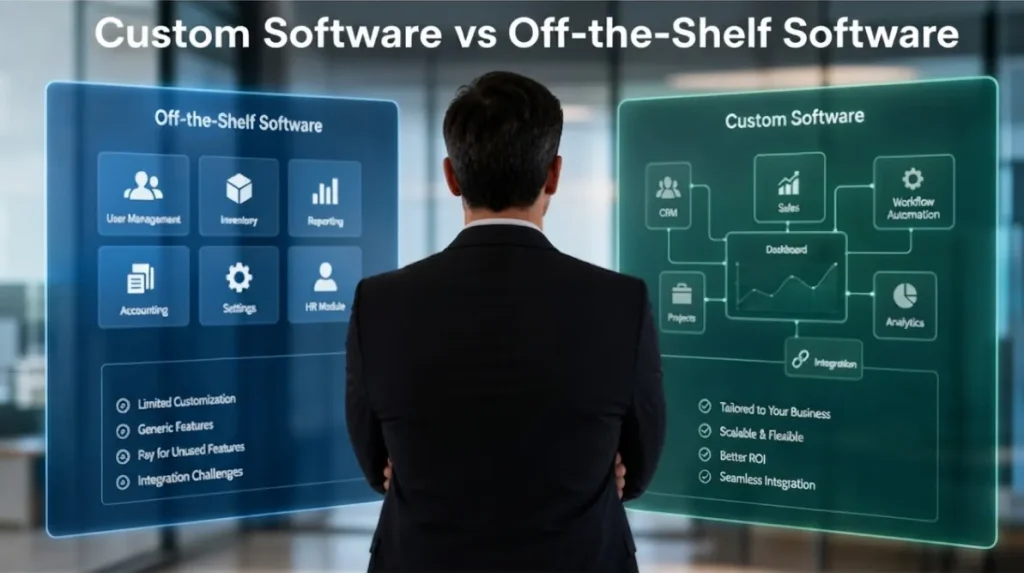
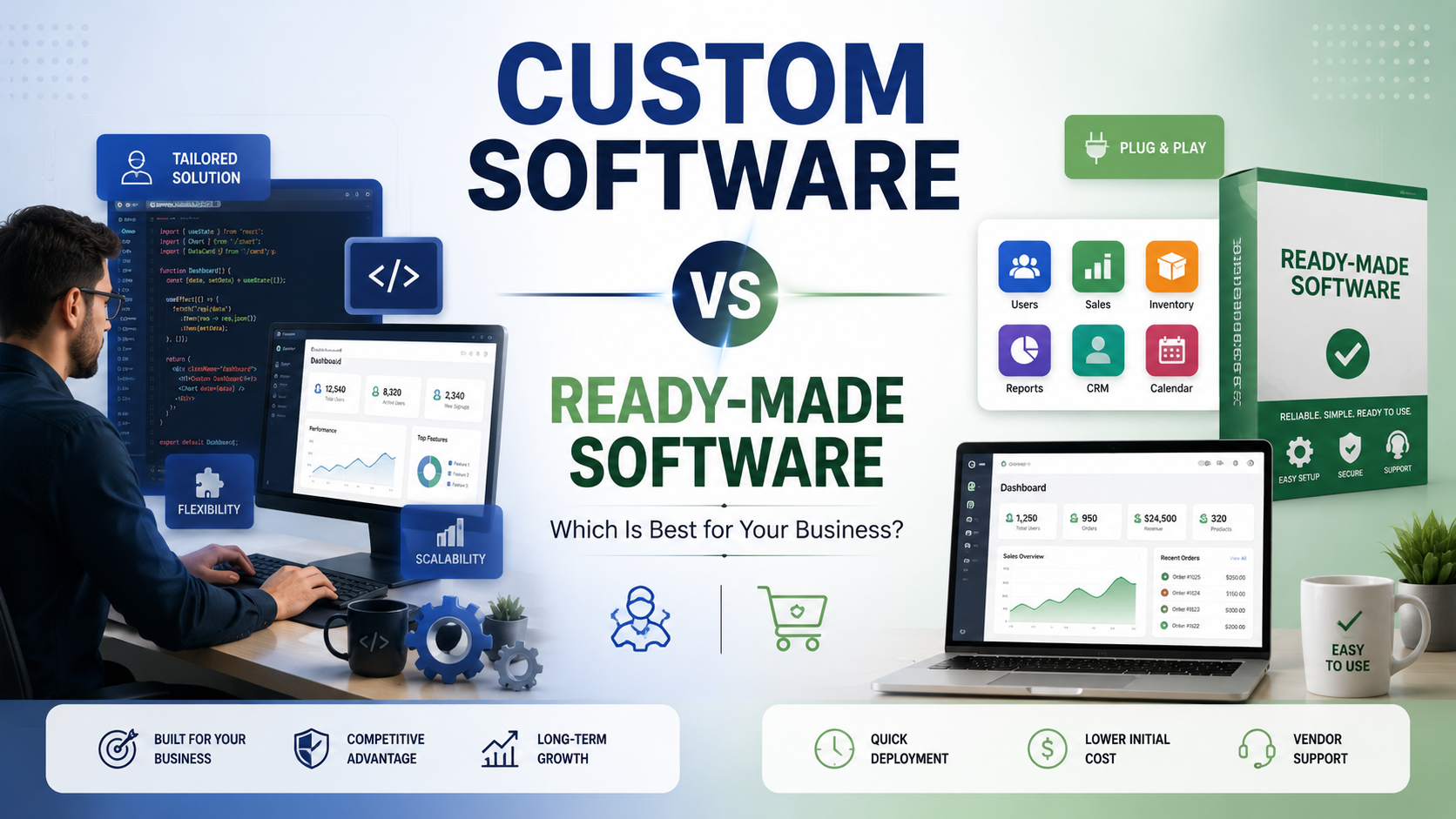
The difference between custom software and ready-made software comes down to control, flexibility, cost, ownership, speed, scalability, and long-term fit.
Factor | Custom Software | Ready-Made Software |
Purpose | Built for your business needs | Built for general users |
Setup time | Longer to build | Faster to start |
Initial cost | Higher upfront cost | Lower upfront cost |
Flexibility | Highly flexible | Limited by available features |
Ownership | Usually owned by the business | Owned by the software provider |
Scalability | Can be designed for growth | Depends on provider plans |
Integrations | Can be built around your tools | Limited to supported integrations |
Workflow fit | Matches your process | Your process must adapt |
Maintenance | Requires technical support | Managed by provider |
Long-term value | Strong if well-built | Good if needs remain simple |
Neither option is automatically wrong. The right choice depends on your situation.
If your business needs a quick and affordable tool for a common task, ready-made software may be enough.
If your business has unique processes, complex workflows, special reports, or integration needs, custom software is usually the stronger choice.
Advantages of Custom Software
Custom software has several advantages, especially for businesses that want more control, better workflow alignment, and long-term scalability.
Built Around Your Business Process
The biggest advantage of custom software is that it follows your actual business process.
Every business works differently. Even businesses in the same industry may have different approval flows, pricing rules, reporting needs, customer handling processes, inventory methods, or staff responsibilities.
Custom software can be designed based on:
- Your departments
- Your user roles
- Your approval process
- Your customer journey
- Your reporting structure
- Your pricing rules
- Your operational workflow
- Your branch setup
- Your data requirements
- Your growth plans
This reduces the need for workarounds.
With ready-made software, you often adjust your business to fit the tool. With custom software, the tool is built to fit your business.
Better Workflow Automation
Custom software can automate repetitive tasks that slow your team down.
These may include:
- Sending follow-up reminders
- Generating reports
- Assigning tasks
- Updating customer records
- Sending email notifications
- Processing approvals
- Tracking payments
- Managing bookings
- Syncing inventory
- Creating invoices
- Routing requests to departments
Automation saves time and reduces human error.
For example, instead of staff manually checking spreadsheets, sending messages, and updating records, the system can handle the process automatically.
That is where custom software starts paying for itself.
Greater Flexibility
Custom software can grow and change with your business.
As your operations expand, you can add new features, modules, reports, integrations, and user roles.
For example, a business may start with a simple CRM and later add:
- Sales pipeline tracking
- Invoice management
- SMS integration
- Customer portal
- Staff performance reports
- Payment gateway
- Mobile app
- AI chatbot
- Branch management
This flexibility is important because businesses evolve. A system that works today may need to support more users, more branches, more customers, and more services in the future.
Ready-made software may not always allow that level of customization.
Stronger Data Control
With custom software, businesses can have more control over how data is stored, accessed, managed, and protected.
This matters when the system handles sensitive information such as:
- Customer records
- Staff information
- Financial data
- Sales reports
- Medical records
- School records
- Business documents
- Payment details
- Operational data
A custom system can include role-based permissions, audit logs, secure access, backups, and data controls based on the business requirements.
This is especially important for companies that need better governance and accountability.
Better Integration With Existing Tools
Many businesses already use tools for email, accounting, ecommerce, payments, marketing, inventory, or communication.
Custom software can be integrated with these tools through APIs.
Examples include:
- Payment gateways
- Accounting software
- Ecommerce platforms
- SMS providers
- Email marketing tools
- Google Calendar
- Google Maps
- CRM systems
- Inventory tools
- Cloud storage
- HR systems
- Shipping providers
API integration helps reduce manual data entry and allows systems to work together.
For a growing business, connected systems are a big deal. Disconnected tools create delays, errors, and confusion.
Competitive Advantage
Custom software can give your business an advantage because it is built around your unique way of operating.
A competitor using the same ready-made tools as everyone else may not have the same level of efficiency, reporting, automation, or customer experience.
Custom software can help you:
- Serve customers faster
- Reduce manual work
- Improve decision-making
- Track operations better
- Build unique customer features
- Create smoother internal processes
- Offer digital services competitors do not have
This matters especially for businesses that want to scale or differentiate themselves in the market.
Long-Term Cost Efficiency
Custom software may cost more upfront, but it can become more cost-effective in the long run when it replaces multiple subscriptions, reduces manual labor, improves productivity, and supports growth.
For example, a business may be paying for separate tools for CRM, reports, bookings, inventory, invoicing, customer communication, and staff management.
A custom platform can centralize these functions into one system.
That does not mean custom software is always cheaper. But when designed properly, it can deliver stronger long-term value.
Advantages of Ready-Made Software
Ready-made software also has clear advantages. It is not a bad option. For many businesses, it is the right starting point.
Faster Setup
Ready-made software can be used almost immediately.
You sign up, configure the settings, add users, and start using it. This is useful when the business needs a quick solution and does not have time to wait for custom development.
For example, if you need basic task management, cloud file storage, or simple accounting, a ready-made tool may solve the problem quickly.
Lower Initial Cost
Ready-made software usually has a lower upfront cost.
Many tools offer monthly or annual subscriptions, free trials, or starter plans. This makes it easier for small businesses to begin using software without a large investment.
This is one reason startups and small businesses often begin with ready-made platforms.
Proven Features
Established ready-made software often comes with tested features, documentation, customer support, and regular updates.
Because many users are already using the product, common bugs may already be fixed, and the provider may continue improving the platform.
This can reduce technical risk for simple business needs.
No Need to Manage Development
With ready-made software, the provider handles hosting, updates, bug fixes, security patches, and general maintenance.
This is convenient for businesses that do not have technical staff or do not want to manage software development.
Good for Standard Business Needs
Ready-made software works well when your needs are simple and common.
Examples include:
- Basic accounting
- Basic project management
- Basic customer records
- Simple appointment scheduling
- Email marketing
- Document storage
- Team communication
- Basic ecommerce
If your process is standard, there may be no need to build custom software right away.
When Ready-Made Software Makes Sense
Ready-made software makes sense when the business needs something simple, fast, and affordable.
It may be the better option if:
- Your business is still small
- Your processes are simple
- Your budget is limited
- You need the tool immediately
- You do not need special features
- You can adapt your workflow to the tool
- You do not need complex reporting
- You do not need custom integrations
- Your team only needs basic functionality
For example, a small business that only needs basic invoicing may not need a custom finance system. A standard accounting platform may be enough.
A startup testing an idea may also begin with ready-made tools before investing in a custom platform.
This is a practical approach. Start simple, validate the need, then build custom software when the business has clearer requirements.
When Custom Software Is the Better Choice
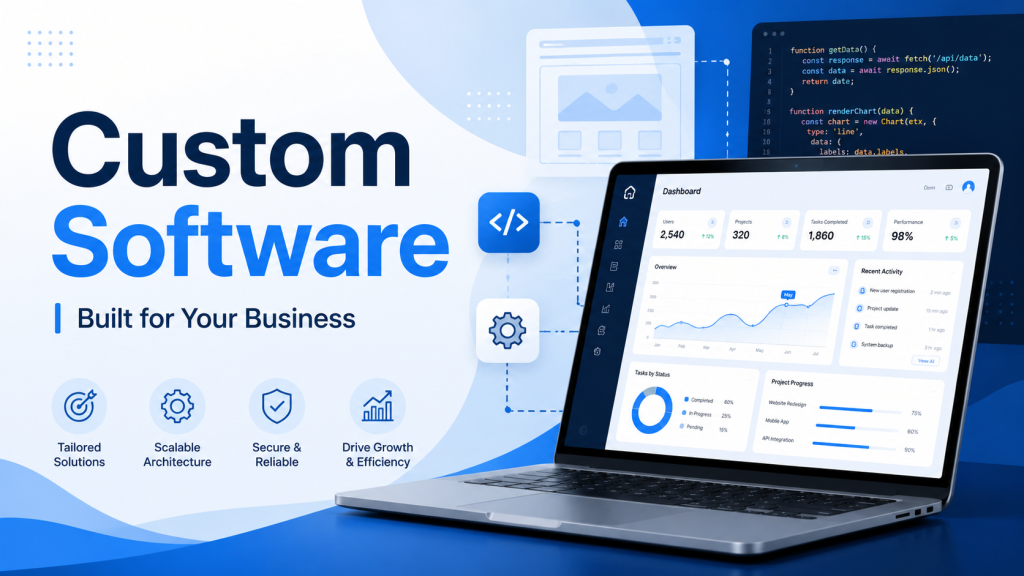
Custom software is the better choice when ready-made tools are limiting your business.
You may need custom software if:
- Your team relies heavily on spreadsheets
- You use too many disconnected tools
- Your staff repeats the same manual tasks every day
- Reports take too long to prepare
- Your workflow does not fit existing software
- You need custom dashboards
- You need specific user roles and permissions
- You need special approval processes
- You need mobile app access
- You need to connect multiple systems
- You need customer or vendor portals
- You need industry-specific features
- You want to build a SaaS product
- You need better control over your data
- You are scaling to multiple branches or departments
A clear sign is when your team keeps saying, “The system cannot do that,” or “We still need to do this manually.”
That usually means the business has outgrown generic software.
Cost Comparison Between Custom and Ready-Made Software
Cost is one of the biggest factors when comparing custom software vs ready-made software.
Ready-made software usually has a lower starting cost. Custom software usually requires a higher upfront investment.
But the long-term cost depends on how the system is used.
Ready-Made Software Cost
Ready-made software may include:
- Monthly subscription fees
- Annual license fees
- User-based pricing
- Feature-based pricing
- Add-on costs
- Integration fees
- Storage fees
- Upgrade fees
- Training costs
The cost may look small at first, but it can increase as the business adds more users, needs higher plans, or requires additional features.
For example, a tool that costs PHP 1,500 per user per month may become expensive when the business has 30, 50, or 100 users.
Custom Software Cost
Custom software may include:
- Planning and consultation
- UI and UX design
- Frontend development
- Backend development
- Database development
- API integration
- Testing
- Deployment
- Training
- Maintenance and support
The upfront cost is higher, but the business gets a system built for its needs.
Custom software may also reduce the need for multiple subscriptions, improve productivity, and support better operations.
Cost Is Not Just About Price
The cheapest option is not always the most affordable in the long run.
A low-cost tool can become expensive if it causes:
- Manual work
- Staff delays
- Duplicate data entry
- Poor reporting
- Customer service issues
- Operational errors
- Missed sales opportunities
- Subscription overload
- Data scattered across platforms
A more expensive custom system can become worth it if it saves time, reduces errors, improves sales, supports customers, and helps the business scale.
Business owners should compare both short-term cost and long-term value.
Which Option Is Best for Your Business?
The best option depends on your business stage, goals, budget, and operational complexity.
Choose Ready-Made Software If:
- You need a quick solution
- Your workflow is simple
- Your budget is limited
- You only need basic features
- You are still testing your business process
- Your team can adapt to the software
- The tool already solves 80 to 90 percent of your needs
Ready-made software is a smart choice when your problem is common and the existing tool solves it well.
Choose Custom Software If:
- Your workflow is unique
- You need advanced automation
- You need custom reports
- You need special user roles
- You need API integrations
- You want to reduce manual work
- You are managing multiple departments or branches
- You need a customer, vendor, or staff portal
- You want to build a software product
- You need long-term scalability
- You want more control over your system and data
Custom software is a better choice when your software needs are directly tied to how your business operates and grows.
Use a Hybrid Approach If Needed
Some businesses do not need to choose only one option.
A hybrid approach can work well.
For example, a business may use ready-made accounting software but build a custom internal system that connects to it. Another company may use an existing payment gateway but build its own booking platform, customer portal, and admin dashboard.
This approach keeps costs practical while still giving the business the custom features it needs.
A hybrid approach may include:
- Ready-made accounting software
- Custom CRM
- Custom booking platform
- Payment gateway integration
- Custom reporting dashboard
- API connection between tools
This is often the most realistic path for SMEs.
How Brayne Software Can Help You Decide
Brayne Software helps businesses review their workflows, identify software gaps, and decide whether custom software, ready-made software, or a hybrid solution is the right choice.
We understand that not every business needs custom software immediately. Sometimes, a ready-made tool is enough. Other times, a business is already losing time, money, and control because its current tools cannot support its operations.
Our role is to help you make a practical decision based on your actual needs.
Brayne Software can help with:
- Custom Software Development
- Internal Business Systems Development
- Custom Web Application Development
- SaaS Application Development
- Mobile App Development
- API Development and System Integration
- AI and Automation Services
- CRM and ERP Development
- POS and Inventory Systems
- Business Portals and Dashboards
We can assess your current process, recommend the right direction, and build a software solution that fits your budget, operations, and long-term growth plans.
FAQs
What is the main difference between custom software and ready-made software?
Custom software is built specifically for your business needs, while ready-made software is designed for general use by many businesses. Custom software gives more flexibility, while ready-made tools are usually faster to launch.
Is custom software better than ready-made software?
Custom software is better when your business has unique workflows, special reporting needs, complex user roles, or integrations that ready-made tools cannot support properly. Ready-made software can still be better for simple and standard business needs.
When should a business use ready-made software?
Ready-made software is useful when the business has simple needs, limited budget, and standard processes that can fit existing software without major customization.
When should a business invest in custom software?
A business should invest in custom software when existing tools no longer match its workflow, reporting needs, automation requirements, or growth plans. It is also useful when the business needs better control over data, user roles, integrations, and customer experience.
Is custom software more expensive than ready-made software?
Custom software usually costs more upfront because it is planned, designed, and developed specifically for one business. However, it may become more cost-effective over time if it reduces manual work, replaces multiple subscriptions, and improves operations.
Can custom software integrate with ready-made tools?
Yes. Custom software can integrate with ready-made tools through APIs. For example, a custom system can connect with payment gateways, accounting software, ecommerce platforms, email tools, SMS providers, or CRM platforms.
Can a small business use custom software?
Yes. Small businesses can use custom software, especially when manual tasks, spreadsheets, and disconnected tools are slowing down daily operations. They can also start with a smaller MVP and add more features later.
Not sure whether your business needs custom software or an existing tool?
Brayne Software can review your workflow and recommend the best solution based on your budget, operations, and long-term goals.
Contact Brayne Software today to request a consultation and discover whether custom software, ready-made software, or a hybrid solution is the right fit for your business.
When comparing custom software vs ready-made software, there is no one-size-fits-all answer.
Ready-made software is useful when your business needs a fast, affordable, and simple solution. It is great for standard processes and early-stage businesses that need to move quickly.
Custom software is better when your business has unique workflows, complex operations, custom reporting needs, integration requirements, or long-term plans to scale.
The wrong software choice can create operational stress. The right software choice can save time, reduce errors, improve customer experience, and give your business better control.
If your business is still small and your needs are simple, ready-made software may be enough for now. But if your team is constantly working around the limitations of your tools, it may be time to consider custom software.